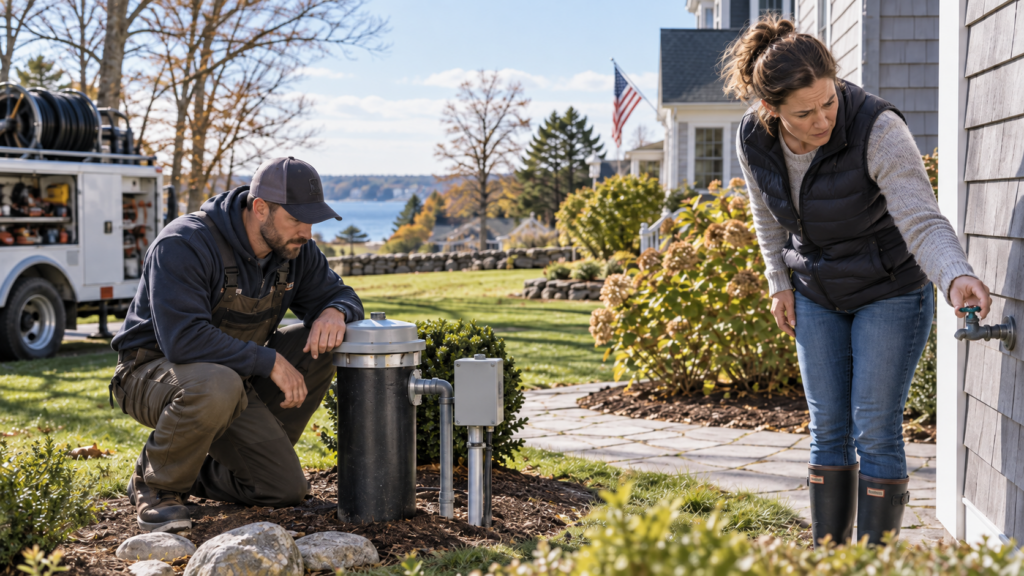
Turn on the tap and get nothing but air? Before you panic — and before you call for service — walk through these emergency checks. Most sudden no-water situations trace back to one of three causes, and about half can be resolved in 30 minutes without a technician on-site.
Do This First (Before Anything Else)
Test multiple fixtures. Check hot and cold water at different sinks, showers, and outdoor spigots.
- If only one fixture is dry, the problem is local — a clogged aerator, a closed shut-off valve, or a frozen pipe on that line.
- If every fixture is dry, the problem is the well system. Continue with the emergency checks below.
Step 1: Check the Power & Breakers
The single most common cause of a sudden no-water event isn’t the pump — it’s the electrical panel. A tripped breaker cuts power to the pump, and the well system quietly stops working.
- Find the well pump breaker. Open your main electrical panel and look for the double-pole (double-wide) breaker labeled for the well pump.
- Look for a tripped position. A tripped breaker sits in the middle position, not fully off and not fully on.
- Reset it once. Flip the breaker completely to OFF, then all the way back to ON. Listen for the pump to start cycling.
- Do not reset a second time if it trips again. An immediate re-trip means a serious electrical fault — a shorted wire, a grounded pump motor, or a seized bearing. Continuing to reset can cause a fire or destroy the pump entirely. Turn the breaker off and call a professional.
Step 2: Read the Pressure Gauge
The small pressure gauge on your pressure tank tells you almost everything you need to know in about five seconds. Find it on the pipe fittings at the bottom of the tank and check what it reads:
Gauge Reads 0 PSI
The system is not building pressure. Either the pump has no power, or it can’t deliver water.
Next step: Inspect the pressure switch (Step 3).
Gauge Reads 40–60 PSI
The well system is holding pressure normally — but water isn’t reaching your fixtures.
Next step: Look for a closed main shut-off valve, a completely clogged sediment filter, or a frozen pipe between the tank and the house.
Step 3: Inspect the Pressure Switch
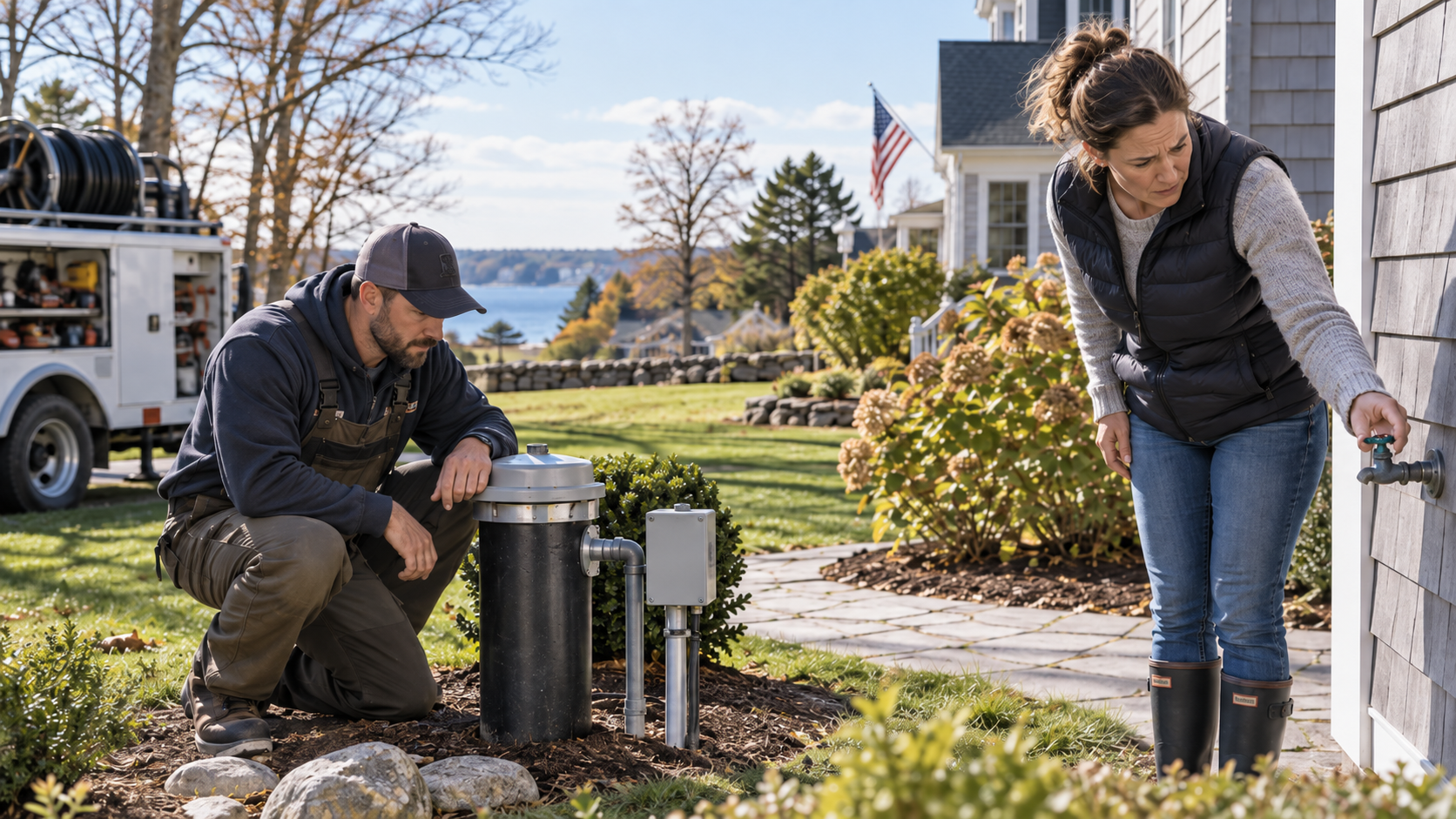
If the gauge reads 0 PSI, the pressure switch — the small grey or black plastic box mounted next to the gauge — is the next place to look. It’s the mechanical brain that tells the pump when to turn on and off.
Three Things to Check on the Pressure Switch
- The low-pressure cutoff lever. Some switches have a small silver lever on the side. If the system ran completely out of water or lost power, this safety trips. To reset it: hold the lever up at a 45-degree angle until you hear water move and see the gauge climb past 12–20 PSI, then let go.
- Stuck or burnt contacts. Turn off the power at the breaker, then remove the plastic cover. Look at the metal contact points inside. If they look welded shut, heavily corroded, or if there’s debris or a dead insect wedged between them, the switch itself needs replacement — a straightforward job for a technician.
- A clogged nipple. The tiny metal tube (nipple) feeding pressure to the switch can plug up with rust or iron mud over time. When it’s blocked, the switch never realizes pressure has dropped and never signals the pump to run. Cleaning or replacing this nipple often fixes the issue.
Step 4: Check for a Waterlogged Pressure Tank
Your pressure tank should hold water in the bottom and pressurized air in the top, separated by a rubber bladder. When the bladder ruptures, the tank fills entirely with water, loses its air cushion, and can’t deliver pressure to the house.
The 5-Second Waterlogged Tank Test
Find the small air valve (Schrader valve, like a tire valve) on top of the pressure tank. Briefly press the pin inward.
- If air hisses out, the tank is healthy.
- If water squirts out, the internal bladder has ruptured. The tank must be replaced — there’s no repair for a failed bladder.
Is It the Well or the Pump?
If the electrical and pressure switch checks come back clean, the problem is deeper — either the well itself has run dry, or a component has failed inside the casing. The timing of the failure is your biggest clue:
Likely a Dry Well
- Water pressure dropped gradually over hours or days
- Sputtering air from taps before things stopped
- Recent heavy use (irrigation, filling a pool, back-to-back laundry)
- You can hear the pump humming but no water arrives
- Massachusetts drought or dry stretch in your area
Likely a Pump / Component Failure
- Water stopped suddenly and completely
- Silence at the pressure tank — no humming, no cycling
- A burning smell or discoloration near the pressure switch
- Breaker trips immediately when you reset it
- Nothing changes even after several hours of rest
If it’s a dry well: shut off the pump breaker immediately — running a submersible pump dry will burn out the motor in minutes. Wait 2 to 4 hours for the aquifer to recover, then try the breaker again. For details on dry-well recovery, see our guide to what to do when your well runs dry.
When to Stop and Call a Professional
Call for Emergency Service Right Away If:
- The breaker trips immediately when you reset it — likely a burnt-out submersible pump motor or a shorted wire in the well casing.
- You smell burning plastic or see scorch marks near the pressure switch or control box.
- The gauge stays at 0 PSI even after resetting the low-pressure lever and cleaning the switch contacts — likely a broken drop pipe inside the well casing or a failed control box.
- You’ve had zero water for more than a few hours with no obvious cause — don’t leave a household without water overnight in Massachusetts freezing months.
- You’re on a 3-wire submersible pump system and pressing the control box reset button does nothing.
Well systems combine 240V electrical work with heavy equipment inside a deep casing. The tools and diagnostic experience matter for both safety and getting the fix right the first time.
Frequently Asked Questions
Why do I suddenly have no water from my well?
How do I reset my well pump?
What is the most common problem with well water?
Is my well pressure tank supposed to have water in it?
What can I do if my well runs out of water?
How do I get water in an emergency without power to the pump?
How long does it take for a well to replenish water?
When should I call an emergency well service?